Many thermoplastic part manufacturing processes generate significant quantities of process scrap. In most cases, manufacturers reintroduce some or all of this process “regrind” back into the primary manufacturing process.
If the end use application does not permit the use of process regrind, the manufacturer must find another use or secondary market for the scrap thermoplastic or regrind.
The runner scrap generated when injection molding parts are produced using a two- or three-plate cold runner mold is a typical example of manufacturing scrap.
[caption id="attachment_4208" align="aligncenter" width="532"]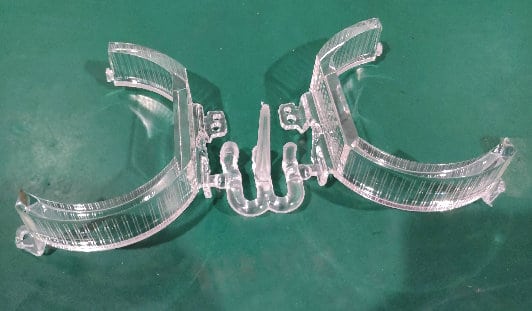 COLD RUNNER SCRAP[/caption]
These cold runners (the feed channels to the mold’s cavities) can represent a very significant percentage of the shot volume, especially for small parts. There are any number of potential processing and part performance issues that can arise in applications where manufacturing scrap is reused.
The scrap must be separated from the molded parts, reground, screened, blended with virgin pellets, and reintroduced into the manufacturing process (or introduced by a calibrated feed system).
Throughout these processes, the scrap must be kept free from contamination. The molded parts themselves contain recycled thermoplastic that can affect the performance of the part, relative to one produced with only virgin thermoplastic.
All of these manufacturing and part performance concerns can be fully eliminated if a “scrapless” manufacturing process is utilized. In the case of injection molded parts, scrapless manufacturing is most easily achieved with the use of hot runner molds.
Unlike cold runners that are ejected at the end of the molding cycle, hot runners remain fluid (melted) and are contained within the mold when the part is ejected.
The hot runner material is then injected as a portion of the molding shot for the subsequent cycle. There is no runner scrap with hot runner processing.
The manufacturing process is streamlined and part quality is improved. The incorporation of a hot runner system into an injection mold is more expensive due to the added complexity of the tool design and associated hardware cost (relative to cold runners).
However, their use does eliminate runner scrap material and handling costs. As a result, hot runners are normally used in higher production applications where they offer a clear economic advantage or in applications where the improved part quality justifies the added expense of the hot runner system.
Scrapless manufacturing is most easily implemented in the process of injection molding, but can apply to other thermoplastic manufacturing processes aswell. Another process that generates significant amounts of manufacturing scrap is thermoforming.
Thermoformed items are produced by heating an extruded sheet to its forming temperature, and reshaping the sheet by vacuum or pneumatic pressure.When circular or cylindrical items, such as a plastic cup, are manufactured by thermoforming, there is a great amount of trim scrap generated.
The trim scrap is normally reground and reintroduced back into the extruded sheet manufacturing process as regrind for continuous thermoforming operations.
The same concerns expressed above apply to this application as well. In recent years, some thermoformed products have been redesigned so that they can be manufactured by the injectionmolding process.
Cylindrical containers can be produced directly by a hot runner, thin wall injection molding process without any process scrap generation. Each of these processes does offer its own relative advantages and limitations with respect to part design, economics, and material capabilities; however, they do compete in many applications.
A key advantage of the injection molding process option is its ability to produce parts without processing scrap generation. A similar comparison can be made between the extrusion blow molding process (that does generate
manufacturing scrap) and the hot runner injection blow molding process (that does not generate manufacturing scrap). The latter is a more complex process that is limited to certain applications and thermoplastics, but does offer the advantage of being scrapless.
If the end use application does not permit the use of process regrind, the manufacturer must find another use or secondary market for the scrap thermoplastic or regrind.
The runner scrap generated when injection molding parts are produced using a two- or three-plate cold runner mold is a typical example of manufacturing scrap.
[caption id="attachment_4208" align="aligncenter" width="532"]
COLD RUNNER SCRAP[/caption]These cold runners (the feed channels to the mold’s cavities) can represent a very significant percentage of the shot volume, especially for small parts. There are any number of potential processing and part performance issues that can arise in applications where manufacturing scrap is reused.
The scrap must be separated from the molded parts, reground, screened, blended with virgin pellets, and reintroduced into the manufacturing process (or introduced by a calibrated feed system).
Throughout these processes, the scrap must be kept free from contamination. The molded parts themselves contain recycled thermoplastic that can affect the performance of the part, relative to one produced with only virgin thermoplastic.
All of these manufacturing and part performance concerns can be fully eliminated if a “scrapless” manufacturing process is utilized. In the case of injection molded parts, scrapless manufacturing is most easily achieved with the use of hot runner molds.
Unlike cold runners that are ejected at the end of the molding cycle, hot runners remain fluid (melted) and are contained within the mold when the part is ejected.
The hot runner material is then injected as a portion of the molding shot for the subsequent cycle. There is no runner scrap with hot runner processing.
The manufacturing process is streamlined and part quality is improved. The incorporation of a hot runner system into an injection mold is more expensive due to the added complexity of the tool design and associated hardware cost (relative to cold runners).
However, their use does eliminate runner scrap material and handling costs. As a result, hot runners are normally used in higher production applications where they offer a clear economic advantage or in applications where the improved part quality justifies the added expense of the hot runner system.
Scrapless manufacturing is most easily implemented in the process of injection molding, but can apply to other thermoplastic manufacturing processes aswell. Another process that generates significant amounts of manufacturing scrap is thermoforming.
Thermoformed items are produced by heating an extruded sheet to its forming temperature, and reshaping the sheet by vacuum or pneumatic pressure.When circular or cylindrical items, such as a plastic cup, are manufactured by thermoforming, there is a great amount of trim scrap generated.
The trim scrap is normally reground and reintroduced back into the extruded sheet manufacturing process as regrind for continuous thermoforming operations.
The same concerns expressed above apply to this application as well. In recent years, some thermoformed products have been redesigned so that they can be manufactured by the injectionmolding process.
Cylindrical containers can be produced directly by a hot runner, thin wall injection molding process without any process scrap generation. Each of these processes does offer its own relative advantages and limitations with respect to part design, economics, and material capabilities; however, they do compete in many applications.
A key advantage of the injection molding process option is its ability to produce parts without processing scrap generation. A similar comparison can be made between the extrusion blow molding process (that does generate
manufacturing scrap) and the hot runner injection blow molding process (that does not generate manufacturing scrap). The latter is a more complex process that is limited to certain applications and thermoplastics, but does offer the advantage of being scrapless.
Comments
Post a Comment